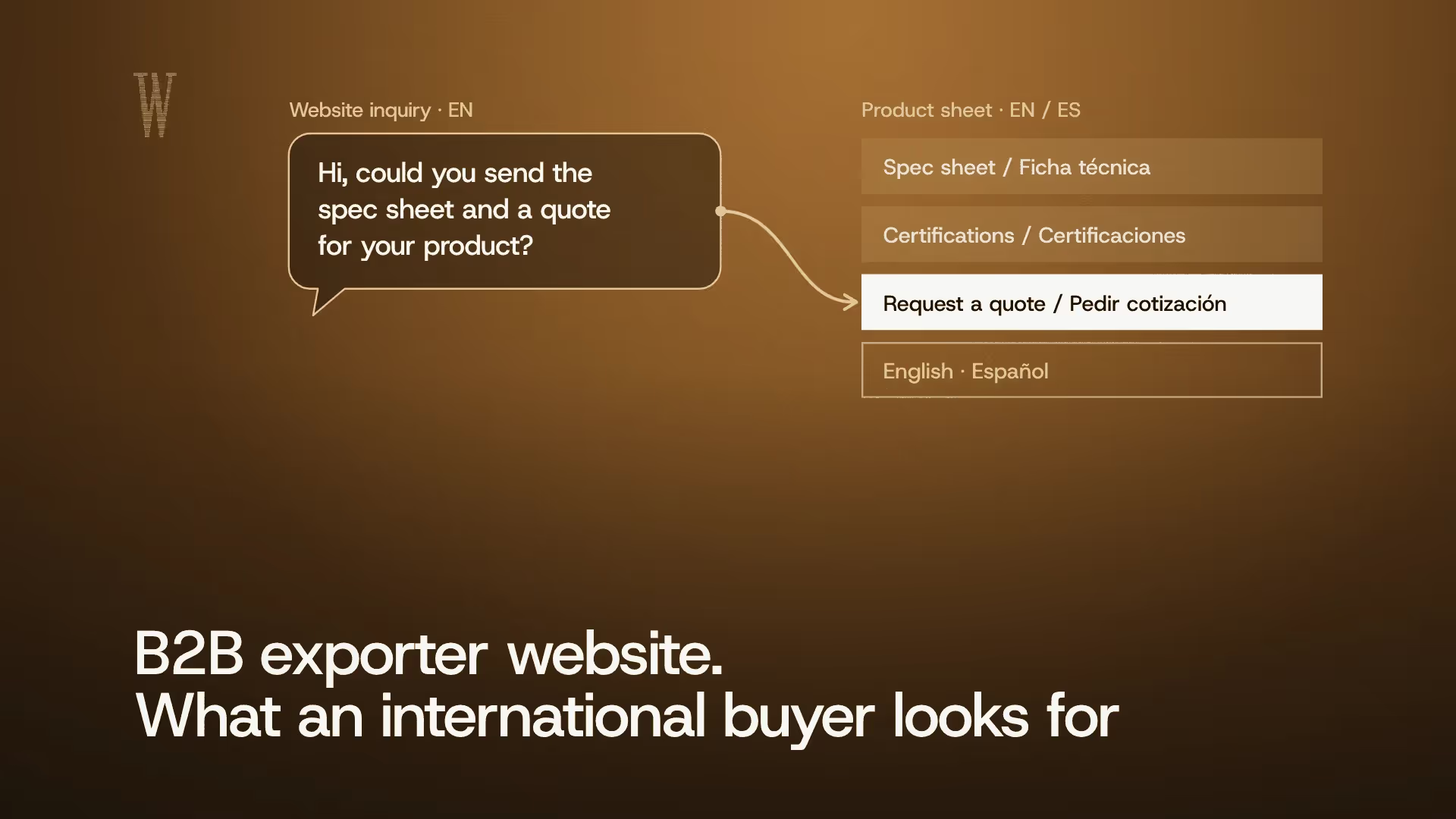
Short answer. An international buyer contacts you when your website answers the basics in their language. What you sell, where it comes from, when it’s available, how it’s certified and how to request a quote.
1. Your full offer in their language
A half-finished English version shows. On the Peruvian Nature website, which we built from start to finish, everything lives in Spanish and English, products and forms included.
2. One page per product, always in the same order
At Peruvian Nature, every superfood has a product page with technical data, seasonality, story and certifications, always in the same order. A buyer who has read the maca page understands the camu camu page without learning a new layout.
3. When it’s available
A seasonality table answers one of an importer’s first questions. If the product depends on the harvest, show it on the product page and explain how real availability gets confirmed.
4. Certifications buyers can verify
A seal in the footer says little. It helps more to show which certification covers which product, and to link the document when it can be published.
5. An inquiry that reaches sales
The form asks for what the sales team needs to reply.
- The product.
- The approximate quantity.
- The destination country.
- Contact details.
At Peruvian Nature, every form sends the inquiry straight to the sales team’s CRM.
Where the form sits matters too. On the OC Forwarding website, an international cargo agency that works with companies that import and export, every page ends with the same contact form. The inquiry is always one step away, in Spanish or in English.
6. Make the service clear before they write
At OC Forwarding, whose site we programmed in full, air and sea cargo come first, and sea freight explains its shared and full container options and the ports it serves. Customers who are already shipping have a link in the menu that takes them straight to tracking.
A catalog your team can keep up to date
If every change depends on a developer, the website goes stale. The Peruvian Nature site is fully manageable, so its own team adds products and updates content. We keep supporting it and adding improvements.
Where to start
Open the page for your most requested product as if you were an importer who doesn’t know you, in English first. Can you tell what it is, when it’s available and how it’s certified? Do you know how to request a quote and who receives it?
If any answer is no, that’s where the work starts. For a website with one main action, the quote request, see the Focused Website.
Tell us what you export and to whom
FAQ
Is translating the website into English enough?
No. Beyond the copy, buyers need the product pages, documents and form in their language. If one part stays in Spanish, the inquiry stops there.
Should I have a PDF catalog or product pages on the website?
They work together. A product page on the website shows up on Google and updates without resending anything. A PDF is handy to attach to an email. What matters is that they say the same thing.
Do I need to publish prices to get inquiries?
Not necessarily. In exporting, many buyers expect to ask for a quote. It helps more to explain how to request one and what details to send.