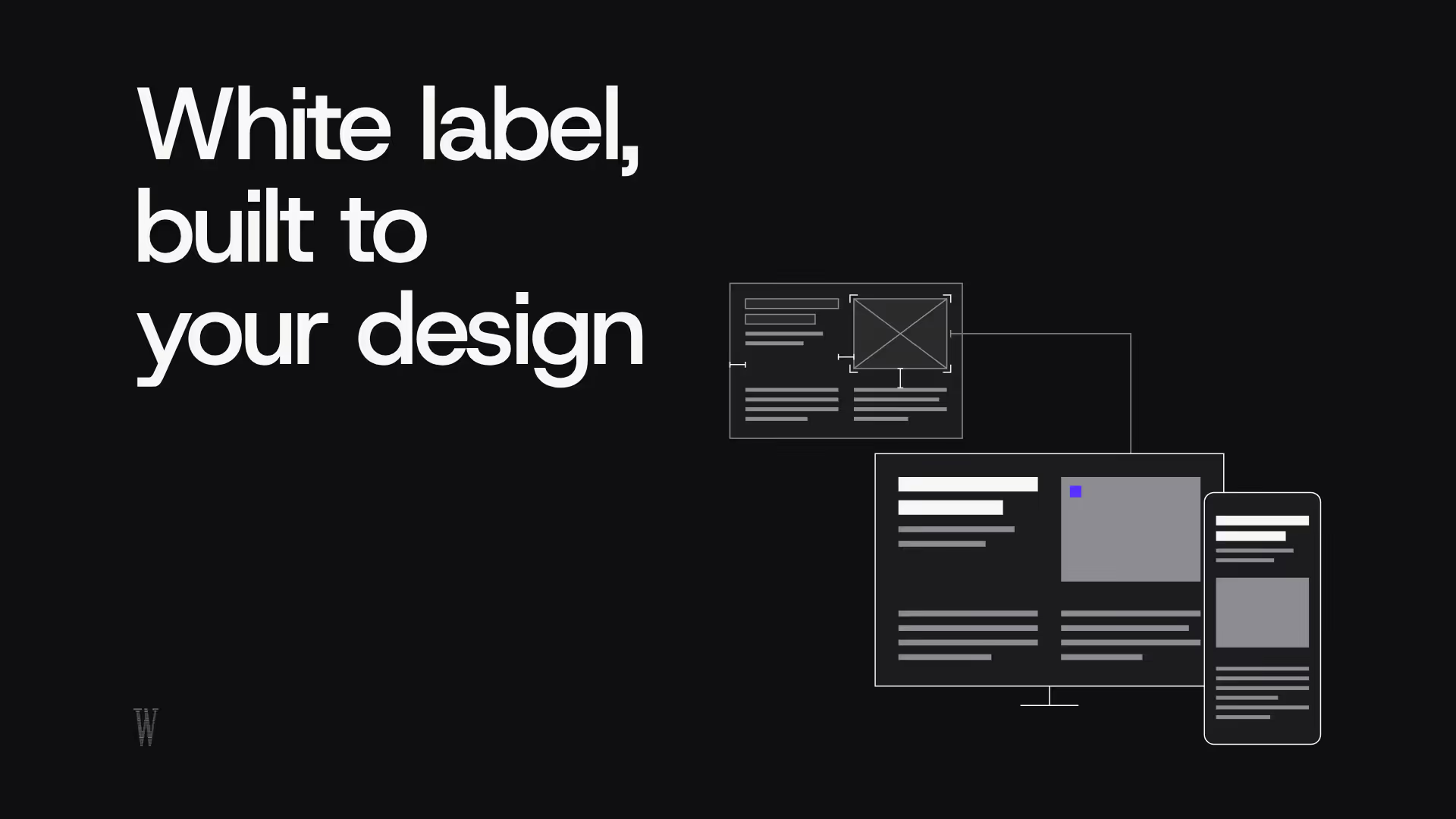
Short answer. White label web development means a partner builds the website your agency designed, and the work goes out under your agency’s name. Your team keeps strategy, design and the client relationship. The partner builds, tests and launches. It works when the design is approved and build-ready, one person approves, and “done” is agreed in writing before anyone writes code.
That’s the whole model. The rest of this guide covers how it runs day to day, what it costs, and the cases where you’re better off without it.
What does a white label web development partner actually do?
A white label partner is the production side of your agency for web projects. You sell the project, run discovery, design the site and present it to your client. When the design is approved, the partner takes it from there: front-end build, CMS setup, forms and integrations, responsive behavior, testing and launch.
Your client talks to you. The partner talks to your team. Some agencies prefer the partner to join client calls under the agency’s name; others keep every conversation in-house. Both work, as long as it’s decided at the start.
The partner can also be a design studio’s regular build team rather than a one-off vendor. Two of our published cases work this way: on the DRU admissions landing, Fibra Studio created the brand and we designed and built the page; on Yobel, Fibra Studio shaped the brand identity and we defined the structure, designed the interface and built it.
Who does what: agency or partner?
The split below is the one that causes the fewest surprises. Anything not on the list gets assigned in writing before the project starts.
| Task | Agency | Partner |
|---|---|---|
| Sales, pricing and contract with the client | ✓ | |
| Discovery, strategy and content plan | ✓ | |
| Visual design and client approval of the design | ✓ | |
| Final copy and images | ✓ (or the client) | |
| Checking the handoff is build-ready | Reviews | ✓ Flags what’s missing |
| Front-end build, CMS and integrations | ✓ | |
| Testing on desktop, tablet and phone | ✓ | |
| Feedback rounds with the client | ✓ Collects and sends | ✓ Applies |
| Launch and handover documentation | Approves | ✓ |
| Ongoing maintenance | Decides if it’s offered | ✓ If agreed |
The rule underneath: one decision channel. If your designer, your account manager and your client all send change requests directly, the partner can’t tell which one wins. One person on your side approves, and every request goes through them.
How does a white label project run, step by step?
Most projects follow the same five steps. The order matters more than the tools.
- Handoff. You send the approved design, every screen version, the content, the expected stack and the deadline.
- Fit check and written estimate. The partner reviews the material and replies in writing: whether it fits, what’s missing and a price. We do this within 24 hours.
- Build. The partner builds against the approved design, not a moving one. If the client asks for new pages mid-build, you see the impact on timeline or price before anyone does the work.
- Review rounds. Your team collects feedback and sends it as one list per round. We include two rounds on what was agreed.
- Launch and handover. The site goes live in your or your client’s environment, with notes on what’s in scope, what’s out and how the CMS works.
If you want the longer version of what happens between an idea and a launched site, we wrote it up in how a website is built.
What does a build-ready handoff include?
Most delays in white label work start before the build: the design arrives without mobile views, or the copy is still a placeholder, or nobody knows who signs off. A handoff is build-ready when it has six things:
- Approved design. The final version your client signed off, not the latest draft.
- Every screen version. Desktop, tablet and phone for each page, not just desktop.
- Content and assets. Final copy, images and fonts, or a clear note on who provides them and when.
- Stack and integrations. The technology you expect and what the site has to connect to (CRM, email platform, booking tool).
- Deadline and decision channel. The date you need and the one person who approves.
- What counts as done. A short written list: what has to work, who approves it and how many rounds there are.
If your team designs in Figma, its Dev Mode lets designers mark frames and sections as “Ready for dev” and lets developers compare versions of a frame, which helps with points 1 and 2 (Figma Help Center). The tool doesn’t replace point 6. That one has to be written down.
In-house developer, freelancer or white label partner: which one fits?
There’s no single right answer. It depends on how many web projects you run and how predictable they are.
| Criterion | In-house developer | Freelancer | White label partner |
|---|---|---|---|
| Cost structure | Salary plus benefits, every month. The US median annual wage for web developers was $92,650 in May 2025 (BLS) | Hourly or per project | Per project or monthly, with a scope agreed in writing |
| Makes sense when | Enough projects to keep someone busy full time | Small, occasional tasks | Steady or growing flow without a full-time load |
| Capacity | One person’s hours | One person’s availability | A team that can take a full build or a bounded task |
| Who covers vacations and sick days | You | Nobody | The partner |
| Process | Yours to define | Usually theirs, informal | Defined: handoff, estimate, rounds, launch |
| Client relationship | Yours | Yours, unless the freelancer goes direct | Yours, by contract |
| Main risk | Paying for idle time | Availability and continuity | A partner that doesn’t fit your quality bar |
Choose in-house if you build enough sites every month to keep a developer fully busy and you want that knowledge inside the agency. Choose a freelancer for small, occasional fixes where a written process would be overkill. Choose a white label partner if your flow of web projects varies month to month, you need full builds as well as small tasks, and you want a defined process without hiring.
How is white label web development priced?
You’ll see three models:
- Per project. A fixed price for a full site, set by scope: pages, templates, animations and integrations. Our Website Build starts at USD 3,300.
- Per task. A fixed price for one bounded job in a site that already exists: new sections, a form connected to a CRM, a speed or mobile fix. Our one-off development project starts at USD 2,200.
- Monthly capacity. A fixed fee for a steady flow of requests. Ours is USD 4,000 a month for one active request at a time, with a queue you order and progress every 2 business days.
Whichever model a partner uses, ask the same question: what counts as done, and what happens when the client asks for more? A fixed price without a written definition of done becomes an hourly rate the moment the first change request arrives. Our current plans and terms are on Partners for design studios and agencies.
Will your client know a partner built the site?
Only if you want them to. In a white label setup the partner doesn’t sign the site, doesn’t contact your client on its own, and doesn’t show the work without your permission. Two things make that explicit:
- An NDA when the agency asks for one.
- A portfolio rule in writing. The work only appears in the partner’s portfolio with your written permission.
Also agree on where the code lives and who owns it. In our case, the code and the site pass to the agency or its client with the final payment.
When you don’t need a white label partner
A partner is the wrong answer more often than people admit. You probably don’t need one if:
- You already keep a developer busy full time. The overhead of handoffs and written scopes only pays off when the flow varies.
- The design isn’t approved yet. A white label partner builds an approved design. If you still need design or branding help, that’s a different service.
- The work is a small edit to a template your team already runs. Changing copy or swapping images in a theme is faster in-house.
- You want someone else to own the client. If you’d rather hand the whole client over, you’re looking for a referral partner, not a white label one.
- Your projects have no approver. If decisions come from three people with no final word, no partner will fix that. Sort the decision channel first.
What to ask before you pick a partner
Before the first project, ask any partner (including us) these questions:
- What do you need from us to call a design build-ready?
- How fast do you reply to a new request, and what does the reply include?
- How many feedback rounds are included, and what counts as a change of scope?
- Who owns the code, and when does it pass to us?
- Do you ever contact our client directly?
- Can we see a live site you built from someone else’s design?
- What time zone do you work in? We work on US Eastern Time, fully within your business hours.
Frequently asked questions
What is white label web development?
It’s a model where a partner builds websites that an agency designs and sells under its own name. The agency keeps strategy, design and the client relationship; the partner builds, tests and launches the site.
How long does a white label website take?
It depends on scope and on how complete the handoff is. Our reference is 2 to 4 weeks for a full website from complete materials, and about 1 working week for a bounded development task.
Do I need a finished design before hiring a white label developer?
Yes. White label development starts from an approved, build-ready design. If the design isn’t approved yet, the project isn’t ready for a build partner.
How much does white label web development cost?
Partners price per project, per task or as a monthly fee. Ours start at USD 3,300 for a full website, USD 2,200 for a one-off development project, and USD 4,000 a month for reserved capacity.
Will my client know I outsourced the website?
Not unless you decide to tell them. The partner works under your brand, signs an NDA if you ask, and only shows the work with your written permission.
Next step
If your agency has an approved design and needs someone to build it under your name, see how Partners works: what we need from you, the three ways to work together and their prices.
Interwwweb · interwwweb.com